Introduction
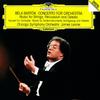
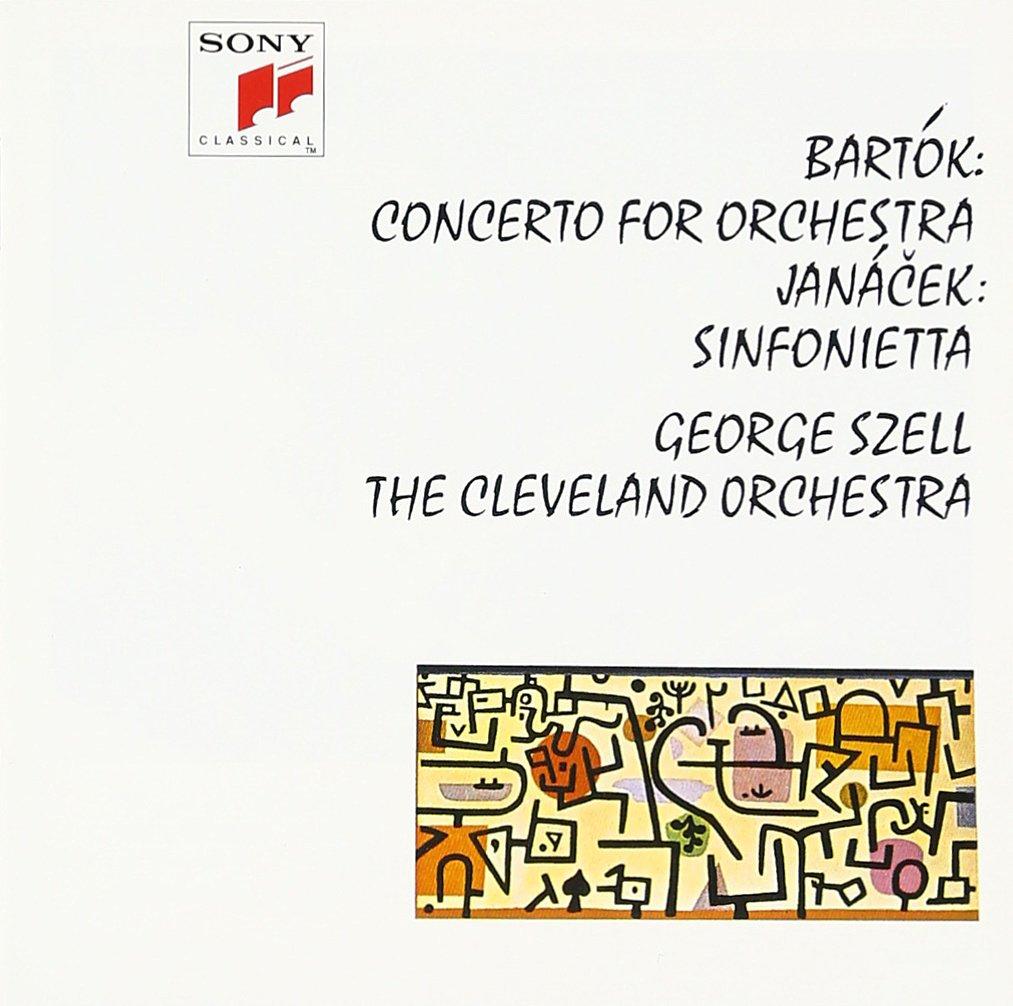
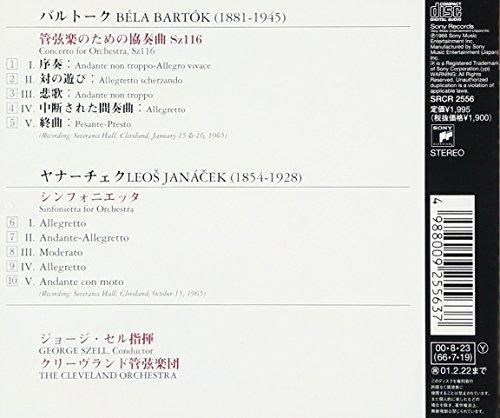
Bartók: Concerto for Orchestra / Janáček: Sinfonietta
George Szell, who served as music director of the Deutsches Opera in Prague (now the Prague State Opera) from 1929 to 1937, favored Czech music. The Sinfonietta is Szell's only recording of Janáček's work, and it is a masterpiece that encapsulates his exceptional conducting skills. The Cleveland Orchestra, beginning with a brilliant opening fanfare, creates a clear yet precise ensemble throughout the entire piece. Bartók's Concerto for Orchestra has been ignored by music critics due to its bold cut in the final movement (measures 426-555) and its unique repetition of the phrase in measure 418 four times before the cut. However, this performance is truly magnificent and well worth a listen. Szell performed this piece with the Cleveland Orchestra and the New York Philharmonic in January 1946, one year and one month after its world premiere in December 1944, and has made it a part of his repertoire ever since. Details of the episode and the cut are included in the liner notes.
The Cleveland Orchestra
Founded in 1918, the Cleveland Orchestra is one of America's "Big Five" orchestras. Based at Severance Hall, it serves as the resident orchestra of the Blossom Music Festival in the summer. The orchestra's past music directors and principal conductors have been as follows: The orchestra's musical directors have included Nikolai Sokoloff (1918-33), Artur Rodzinski (1933-43), Erich Leinsdorf (1943-46), George Szell (1946-70), Pierre Boulez (1970-72), Lorin Maazel (1972-82), Christoph von Dohnányi (1984-2002), and, since 2002, Franz Welser-Möst.
The orchestra's level rose dramatically during George Szell's 24 years as music director, delivering ideal performances that beautifully blended the traditional beauty of his European upbringing with his perfect American qualities. In addition to impeccable technique, the orchestra is known for its high-purity ensemble, sometimes described as chamber music-like, and its ability to express subtle nuances, solidifying its reputation as one of the world's leading orchestras.
The Cleveland Orchestra
Founded in 1918, the Cleveland Orchestra is one of America's "Big Five" orchestras. Based at Severance Hall, it serves as the resident orchestra of the Blossom Music Festival in the summer. Past music directors and principal conductors include:
Nikolai Sokoloff (1918-33), Artur Rodzinski (1933-43), Erich Leinsdorf (1943-46), George Szell (1946-70), Pierre Boulez (1970-72), Lorin Maazel (1972-82), Christoph von Dohnányi (1984-2002), and, since 2002, Franz Welser-Möst.
Media reviews and more
This album commemorates the 30th anniversary of George Szell's death. A 1965 recording featuring the Cleveland Orchestra. (C)RS
About the Artist
George Szell (Conductor)
GEORGE SZELL, Conductor
Born June 7, 1897, in Budapest, Hungary. He moved to Vienna at the age of three, studied piano with Richard Robert, and gave his first public performance at age 11. Szell made his conducting debut at age 16, conducting the Vienna Symphony Orchestra in place of the ill resident conductor at the Bad Kissingen Summer Concert. The following year, he appeared as conductor, pianist, and composer at a concert with the Berlin Philharmonic. Trained by Richard Strauss, he embarked on a career as a conductor. He began his career at the Strasbourg Opera House, then served as first conductor at the Darmstadt Court Opera House and the Düsseldorf Stadtstheater. From 1924 to 1929, he served as principal conductor of the Berlin State Opera and the Berlin Radio Symphony Orchestra. He also served as a professor at the Berlin Conservatory. In 1929, Szell traveled to Prague, where he became general music director of the Deutsche Oper and Philharmonic Concert Hall and professor at the Academy of Music and Drama. During this time, he began guest conducting with leading European orchestras, and in 1930 and 1931 he traveled to the United States under an exclusive contract with the St. Louis Symphony Orchestra. In 1939, while returning from Australia via the United States to Europe, he was stranded in New York due to the outbreak of World War II and was forced to remain in the United States.
At the invitation of Toscanini, Szell made his New York debut in 1941 as guest conductor of the NBC Symphony Orchestra. He subsequently signed contracts with orchestras in Boston, New York, Philadelphia, Chicago, Los Angeles, Detroit, and Cleveland. From 1942 to 1946, he served as principal conductor of the Metropolitan Opera, conducting works by Richard Strauss and Wagner, among others. Since 1944, he has been one of the New York Philharmonic's permanent guest conductors, and in 1969 he became its music advisor.
In 1946, he succeeded Reinsdorf as music director of the Cleveland Orchestra, where he built a refined ensemble through astonishingly rigorous training, transforming the orchestra into one of the finest orchestras of the modern era. Szell's signature qualities lie in the balance of refined, crystal-clear sound, utterly clean and refined expression, and flawless form. And therein lies the ideal of a great musicianship for a conductor, brilliantly unearthing the pure musical beauty of every work, while always appearing to stand calmly outside the music. Szell made a deep impression on Japan with the Cleveland Orchestra in May 1970, during the Osaka World's Fair. However, his sudden death upon his return to Japan left many fans in mourning. He was particularly renowned for his elegant interpretations of Mozart, Beethoven, and Brahms, which he delivered based on his many years of experience in Europe.


 Remboursement en cas de non-livraison